From the first email to the reorder, every account follows the same six steps. Below them: a glossary of the packaging terms you will see on a catalog, a reorder point calculator, and answers to common questions.
Accounts open by email. Tell us who you are and what you sell, and we confirm the details before the first order. We sell wholesale to businesses, so we ask for the information a distributor needs to set up a business account.
What we ask for
Business name and store type
Categories you plan to order
Estimated monthly volume
Delivery address and receiving details, such as dock or no dock
02
Step 02
Catalog and pricing on request
Once your account is set up, we send a catalog and pricing for the categories you buy. Each line lists the item, its case pack, and the case dimensions, so you can plan shelf space before you order.
Minimum orders vary by category and are confirmed when your account is set up.
03
Step 03
Full cases or mixed pallets
Distributors sell by the case. A case holds a set number of sellable units, called the case pack. Order as many full cases of a line as you need.
When an order covers several categories, it can ship as a mixed pallet: one pallet carrying cases from many lines. It is the simplest way for a smaller store to get paper, cleaning, household, and pet products on a single delivery.
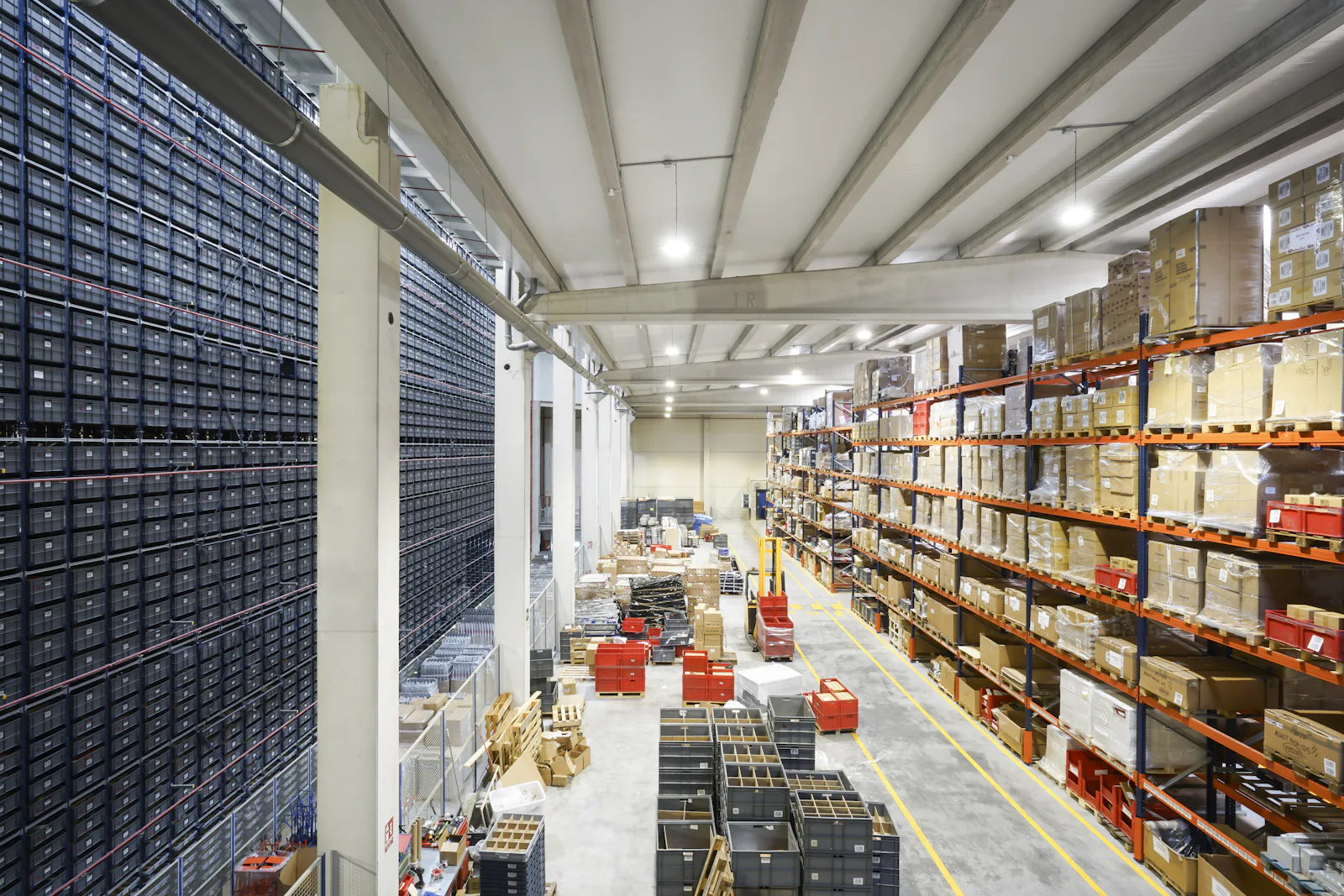
Fig. 02A warehouse floor with racking and a picking area
04
Step 04
Pick and pack
Each order is picked case by case and checked against the order before it is packed. Small orders are packed into cartons for parcel shipping. Larger orders are built onto a pallet.
A pallet is built the way freight carriers recommend: heavy and sturdy cases on the bottom, lighter and crushable cases on top, nothing hanging over the edges, and the finished load stretch-wrapped so it travels as one unit.
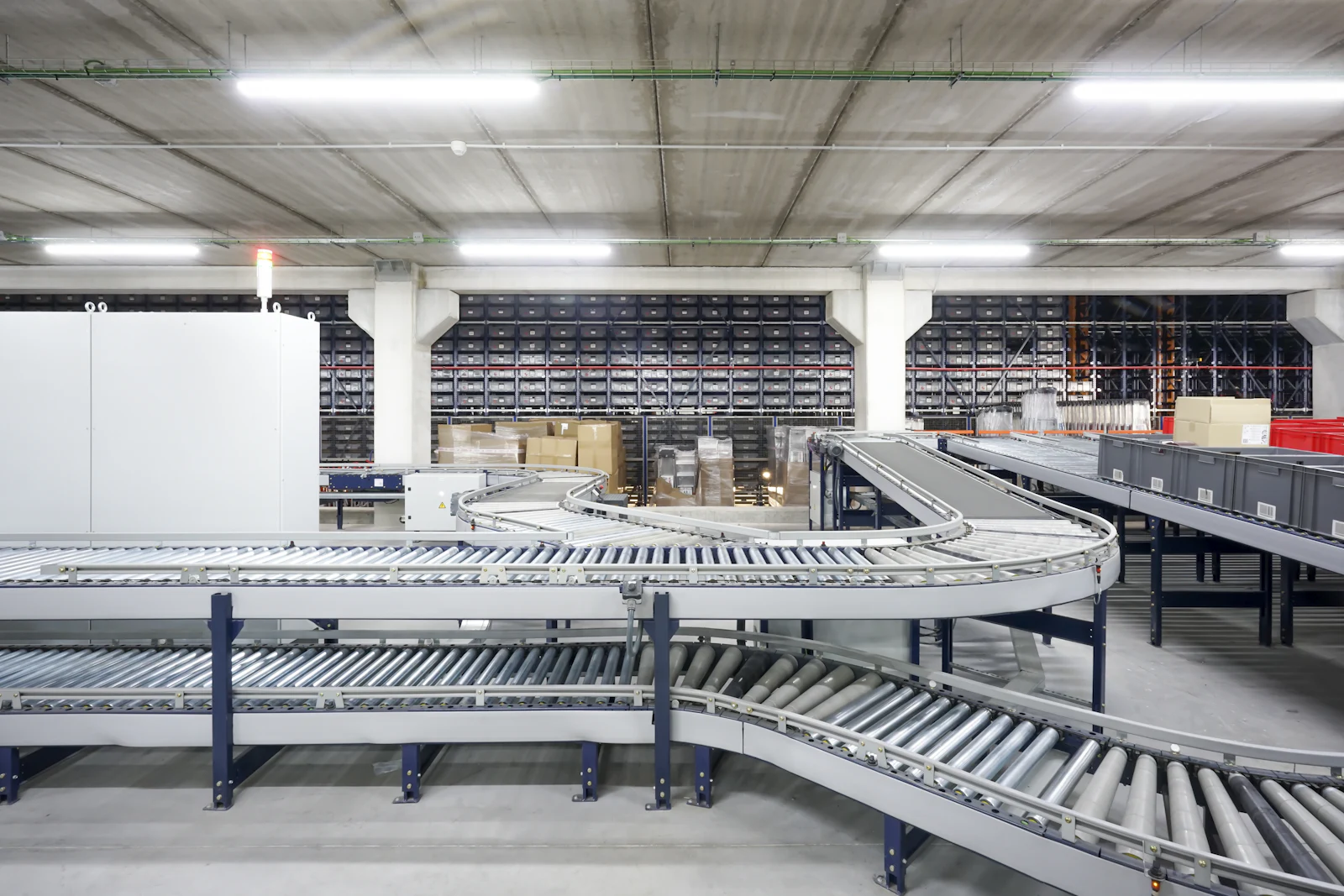
Fig. 03Roller conveyor lines in a warehouse
05
Step 05
Parcel or LTL shipping
Illustration only. It does not show service areas, routes, or delivery times.
Parcel. Small orders ship as individual cartons through parcel carriers, each with its own tracking number. Major parcel carriers generally accept packages up to 150 pounds, with limits on length and girth.
LTL freight. Palletized orders usually ship less-than-truckload. Your pallet shares a trailer with other shippers' freight, and the price depends on weight, freight class, distance, and any added services. Every LTL shipment travels with a bill of lading.
No loading dock? LTL carriers can usually deliver with a liftgate truck that lowers the pallet to the ground. It is an added service, so tell us when you set up your account.
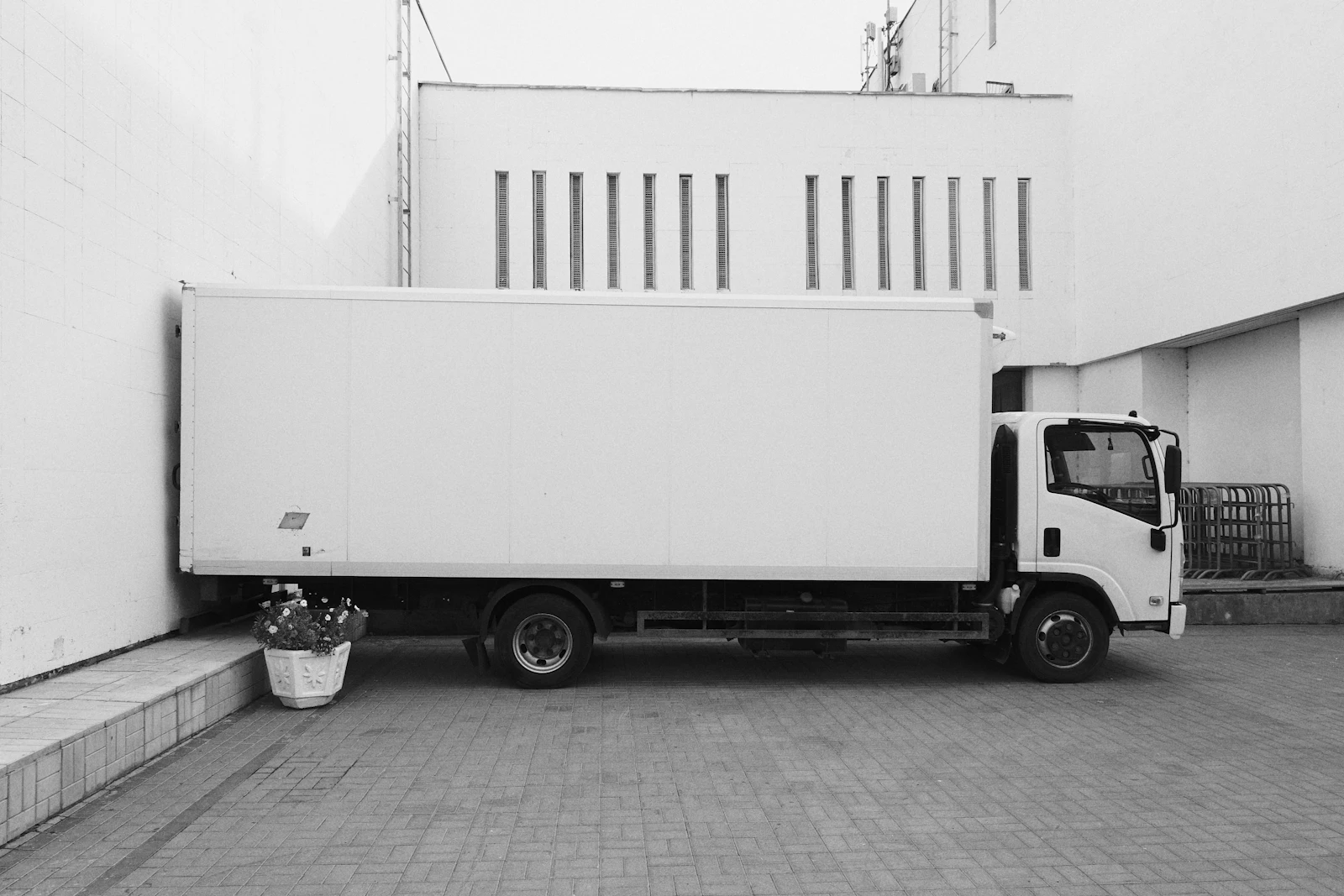
Fig. 04An unmarked box truck
06
Step 06
Receiving and reorders
When a freight delivery arrives, check it before you sign. Count the pieces against the bill of lading and the packing list, and look for crushed corners, torn wrap, or wet cartons. Write any shortage or damage on the carrier's delivery receipt, in specific words, then email us. Damage found after signing has to be reported as concealed damage, and carriers allow only a short window for that.
Count pieces against the paperwork
Note damage on the delivery receipt before signing
Email us photos of anything wrong
Reorder by email when stock reaches your reorder point
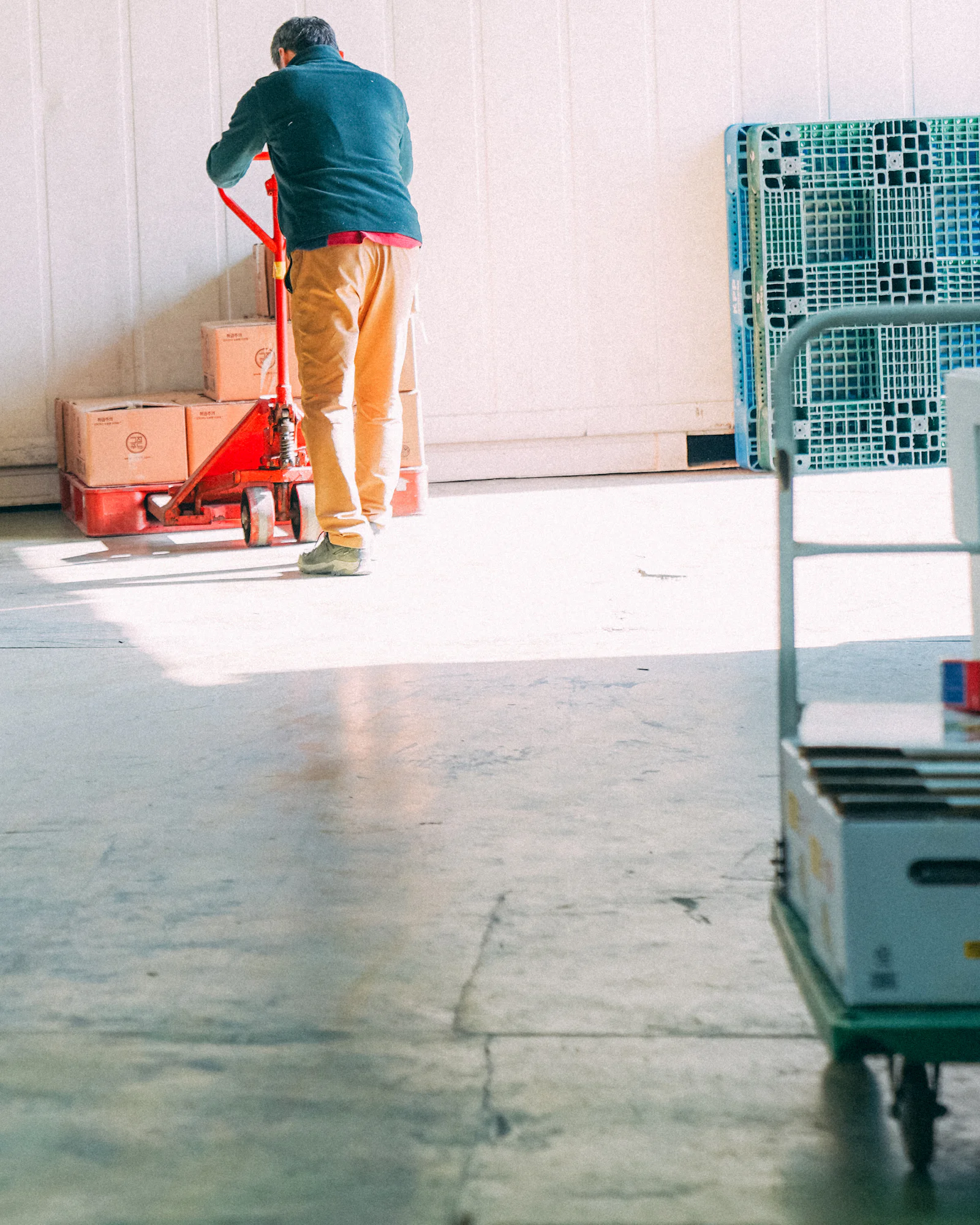
Fig. 05Moving cases on a pallet jack
07Packaging glossaryNine terms
Read a catalog like a buyer.
The words on a wholesale catalog, a pallet label, and a freight bill, in plain English.
Each
EA
One sellable unit: a single bottle, roll, or box. The smallest packaging level, and what your customer buys.
Case pack
CS
The number of eaches in one shipping case. A case pack of 12 means each case holds 12 units.
Order 3 cases of a 12-pack line and you receive 36 units.
Inner pack
IP
A smaller bundle of eaches inside the case, so a store can open part of a case at a time.
A case of 24 might hold 4 inner packs of 6.
Master case
MC
The outer shipping carton that holds the eaches or inner packs. It is the standard unit for ordering, storing, and shipping.
Pallet tie and high
TI × HI
Tie is the number of cases in one layer of a pallet. High is the number of layers. Multiply them to get the cases on a full pallet.
A tie of 10 and a high of 5 is 50 cases.
GMA pallet
48 × 40
The 48 by 40 inch wooden pallet, the most common pallet size in the United States. The name comes from the Grocery Manufacturers Association.
LTL
LTL
Less-than-truckload: freight that does not need a whole trailer, so it shares space with other shippers' freight. Priced mainly on weight, freight class, distance, and added services.
A full truckload, or FTL, fills a trailer with one shipper's freight.
GTIN and UPC
GTIN
A GTIN, or Global Trade Item Number, is the GS1 number that identifies a product. The UPC-A barcode on a retail unit carries a 12-digit GTIN. Shipping cases usually carry a 14-digit GTIN, often printed as an ITF-14 barcode.
Bill of lading
BOL
The document that travels with a freight shipment. The carrier signs it at pickup, and it serves as the receipt for the goods and the contract for carrying them.
08Reorder point calculatorEstimate
When should you reorder?
Your reorder point is the stock level that tells you to order again, with enough on the shelf to cover the wait for the delivery plus a cushion. Enter your numbers for one item.
Your reorder point
Reorder at96units on hand
Suggested cases8full cases
8 full cases of 12 cover it exactly.
Lead-time demand: 60.0 unitsSafety stock: 36.0 units
Daily sales = weekly units ÷ 7 84 ÷ 7 = 12 units a day
Reorder point = daily sales × (lead time days + safety stock days)
Cases = reorder point ÷ units per case, rounded up
Estimate
This is the standard reorder point formula with safety stock counted in days of supply. It assumes steady sales and the lead time you entered. Real demand moves with seasons, promotions, and paydays, so treat the result as a starting point.
Minimum orders vary by category and are confirmed when your account is set up.
02How do I get pricing?
Catalog and pricing are sent on request once your account is set up, for the categories you plan to buy.
03Can I mix categories on one order?
Yes. Orders across several categories can ship together as a mixed pallet, built with heavy cases on the bottom and light ones on top.
04How will my order ship?
Small orders ship as cartons by parcel carrier. Palletized orders ship as LTL freight. We choose the method that fits the order and confirm it with you before it ships.
05How long does delivery take?
It depends on the shipping method, the carrier, and the distance, so we do not quote a standard time on this site. We share the shipping details when your order leaves.
06What if something arrives damaged or short?
Note it on the carrier's delivery receipt before you sign, take photos, and email us the same day. We will work with you and the carrier to sort it out.
07Do you sell to consumers?
No. We sell wholesale to businesses: stores, online sellers, and offices and facilities.
08Which brands do you carry?
The catalog for your account lists the brands and items available to you. If you are looking for a specific product, ask us.
09Do chemical products come with Safety Data Sheets?
Yes. OSHA's Hazard Communication Standard requires distributors to provide Safety Data Sheets for hazardous chemicals to the employers they sell to, with the first shipment and again with the first shipment after an SDS is updated. Ask us any time for a current copy.